Local catchment water is the oldest of Singapore's four national taps, predating NEWater and desalination by decades. What began as a handful of rural reservoirs in the colonial era has expanded into an engineered network of 17 reservoirs that capture rainfall from approximately two-thirds of the country's 728 square kilometre land area.
The expansion was deliberate and incremental. Between 2008 and 2011, PUB added three reservoirs in urbanised areas — Marina, Punggol and Serangoon — pushing the water catchment boundary from previously forested regions into the city centre itself. The Marina Reservoir, created by damming the mouth of the Marina Channel, was the most significant of these additions.
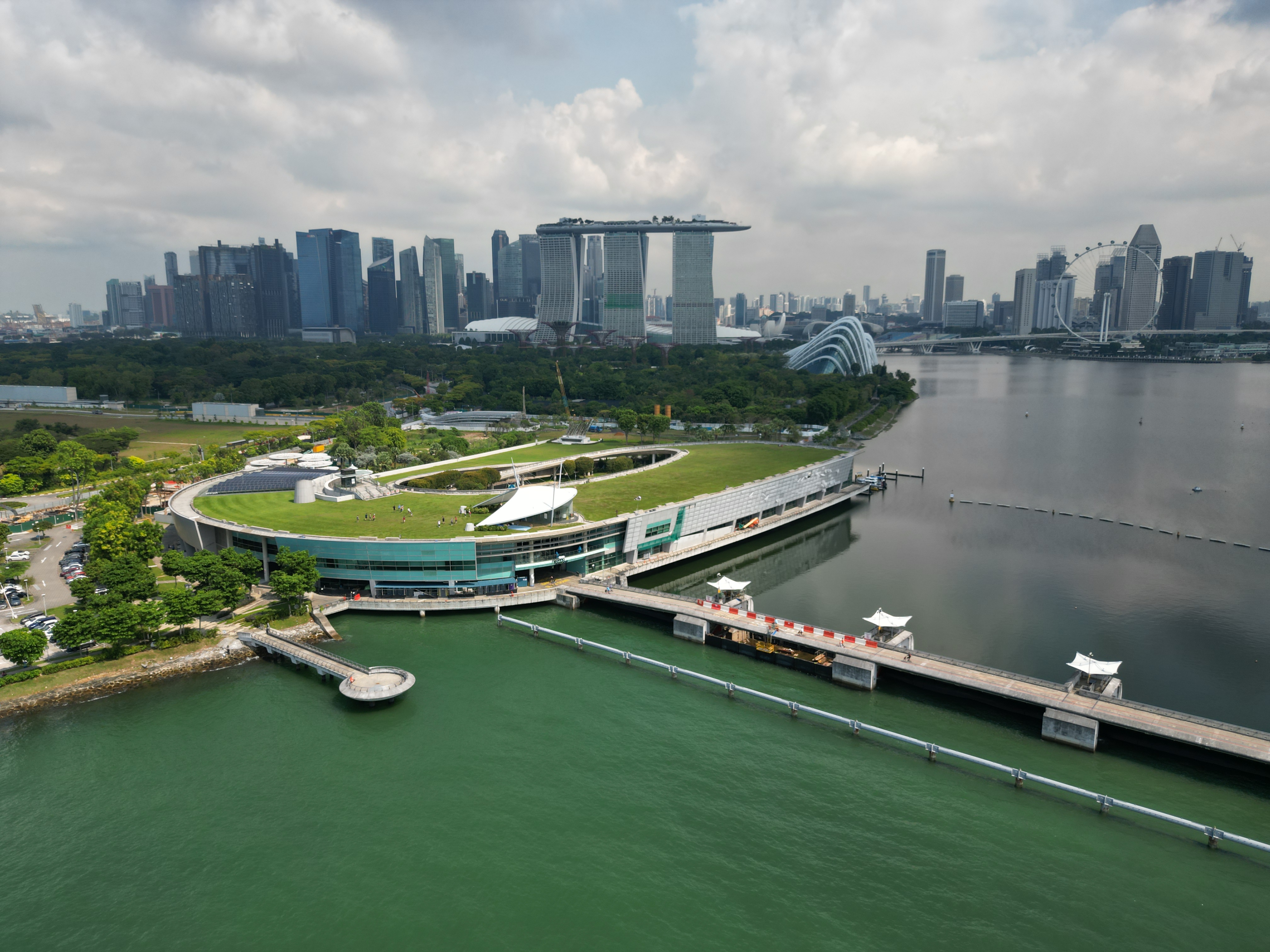
Marina Barrage: Engineering Details
Marina Barrage is a 350-metre-wide dam built across the Marina Channel, separating the freshwater Marina Reservoir from the tidal seawater of the Singapore Strait. Completed in 2008, it is Singapore's 15th reservoir and the first located within the Central Business District.
The barrage performs three functions simultaneously:
- Freshwater reservoir — rainfall collected across the 10,000-hectare Marina catchment (the largest and most urbanised in Singapore) flows into the reservoir. Natural desalination through continuous rainwater replacement converted the previously brackish body to freshwater by April 2009, and the reservoir was officially commissioned as a freshwater source in November 2010.
- Flood control — nine hydraulic crest gates release excess stormwater into the sea during low tide. When high tide prevents gravity drainage, seven large-capacity pumps (each rated at 40 cubic metres per second) actively drain water to prevent flooding in the low-lying Chinatown, Jalan Besar and Geylang areas.
- Recreational space — the barrage maintains a constant water level regardless of tidal conditions, enabling water sports, community events and a rooftop green space with solar panels.

The 17-Reservoir Network
Singapore's reservoirs span from forested central catchments to dense urban zones:
Central Catchment Reservoirs
MacRitchie, Upper Seletar, Lower Seletar, Upper Peirce and Lower Peirce reservoirs sit within the Central Catchment Nature Reserve. These are the oldest in the network, with MacRitchie dating to 1868. The forested catchments provide naturally filtered water with relatively low treatment requirements.
Western Catchment
Kranji, Pandan, Jurong Lake, Murai, Poyan, Sarimbun and Tengeh reservoirs serve the western zone. Several of these collect water from the industrialised Jurong area, requiring more intensive pre-treatment.
Urban Catchment (Post-2008)
Marina, Punggol and Serangoon reservoirs represent the newest generation. Their addition expanded the total water catchment from roughly half to two-thirds of Singapore's total land area — a significant achievement for a densely built-up island.
ABC Waters Programme
PUB's Active, Beautiful, Clean Waters (ABC Waters) programme redesigns drains, canals and reservoirs into naturalised waterways that integrate stormwater management with public recreation. More than 100 ABC Waters projects have been completed across Singapore.
The programme applies bioengineering techniques — constructed wetlands, rain gardens, bioretention swales — that slow runoff, filter pollutants and recharge catchment water quality before it enters reservoirs. Bishan-Ang Mo Kio Park is the most frequently cited example, where a concrete drainage canal was converted into a 3-kilometre naturalised river with surrounding parkland.
Climate Adaptation Challenges
Singapore receives an average of 2,400 millimetres of rainfall annually, among the highest for any major city globally. However, distribution is uneven: the northeast monsoon season (November to January) brings concentrated rainfall, while inter-monsoon periods can produce extended dry spells.
Climate projections indicate that rainfall intensity will increase while distribution becomes less predictable. Sea level rise also threatens the freshwater quality of coastal reservoirs. PUB's long-term strategy balances catchment expansion with growing investment in weather-independent sources (NEWater and desalination) to buffer against this variability.